
Who Really Governs a Non-Profit?
We often say that boards govern and executives manage. It is a useful distinction, but in many non-profit organisations it describes the constitutional theory rather better than the organisational reality.
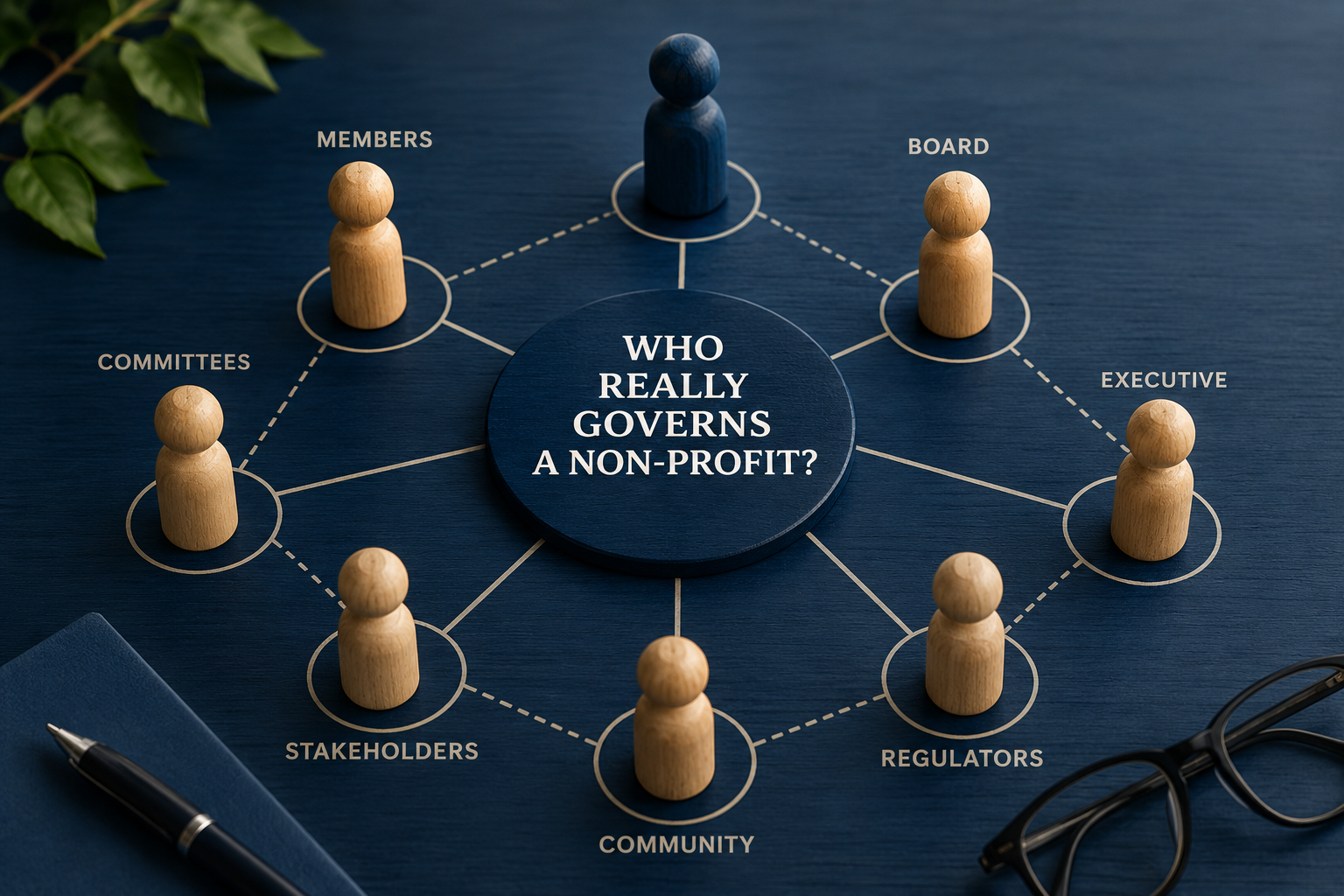
In a charity, membership body, professional association or sporting federation, authority can be distributed across trustees or directors, members, executives, committees, branches, regulators and sometimes founders or other influential stakeholders.
Understanding who really governs an organisation therefore requires more than reading the constitution. It requires understanding where authority formally sits, where influence actually resides, and how decisions are made in practice.
This matters because many governance problems are, at their heart, problems of unclear authority. Boards stray into operational matters. Executives make decisions that properly belong to the board. Committees acquire powers nobody intended them to have. Members assume rights that the constitution does not give them or discover that apparently extensive constitutional rights provide surprisingly little practical influence.
Good governance starts with being clear about who can decide what, on whose behalf and subject to what accountability.
What do we actually mean by governance?
The word “governance” is used remarkably loosely.
It can refer to board meetings and minutes, compliance, regulation, policies, risk management, constitutions, trustee duties and almost anything else associated with organisational oversight.
But governance is fundamentally about authority, decision-making and accountability.
Every organisation has to answer a series of deceptively simple questions. Who has ultimate responsibility for the organisation? Who can make decisions on its behalf? Which decisions can be delegated? To whom? How is the exercise of that authority scrutinised? And what happens when different parts of the organisation disagree?
A well-governed organisation has reasonably clear answers.
That does not mean every decision must be prescribed in a lengthy scheme of delegation. Indeed, governance can become less effective when excessive documentation attempts to anticipate every eventuality.
It does mean that the people exercising authority should understand the source and limits of that authority.
That distinction is particularly important in the non-profit sector because organisational purpose replaces the relatively straightforward commercial objective around which a conventional business can often organise itself. A non-profit may have beneficiaries, members, donors, regulators, volunteers, employees and wider public-interest obligations, all with legitimate but potentially different expectations.
Governance is the architecture through which those competing interests are converted into legitimate organisational decisions.
Formal authority: start with the constitution
The obvious starting point is the organisation's governing document.
Depending on the organisation, that might be articles of association, a charitable constitution, rules, statutes, a Royal Charter or some combination of these.
These documents establish the formal distribution of power.
For a company, the board will normally possess extensive authority to manage the organisation's affairs, subject to powers specifically reserved to members and the requirements of company law. In a charity, trustees carry duties that cannot simply be transferred elsewhere. Membership organisations may reserve significant constitutional powers to their members.
But reading the constitution is only the beginning.
Most substantial organisations delegate extensively. Boards delegate to chief executives. Chief executives delegate throughout management structures. Boards establish committees. Constitutions may create councils, representative bodies, regional structures or specialist panels.
The result is a network of authority rather than a simple hierarchy.
That network needs to remain connected to its constitutional source.
A committee should know whether it is deciding, recommending or advising. An executive should know which matters require board approval. A board should understand which decisions the constitution reserves to members.
Without that clarity, organisational custom starts replacing formal authority.
“We have always done it this way” is not a particularly persuasive source of governance power.
Members complicate the picture
Membership organisations present one of the most interesting governance challenges.
It is tempting to regard members as equivalent to shareholders. Sometimes the analogy is useful, but it can also be misleading.
Shareholders own an economic interest in a company. Members of a professional association, charity or sporting body generally do not own the organisation in that sense. Nevertheless, the constitution may give them important powers: electing directors, removing office-holders, amending constitutional provisions or approving particular decisions.
This creates a tension between representative legitimacy and board responsibility.
A director or trustee may have been elected by a particular constituency, region or professional group. Once appointed, however, their duty is generally not simply to act as that constituency's delegate. They join a collective governing body responsible for the organisation as a whole.
That distinction is easy to state and sometimes difficult to maintain.
Representative governance can give organisations legitimacy, particularly where participation and membership are central to their purpose. But a board assembled entirely around constituencies can struggle to behave as a coherent governing body rather than a parliament of competing interests.
Conversely, a wholly skills-based board may be technically impressive but feel remote from the community from which the organisation derives its legitimacy.
There is no universal solution.
The important point is that organisations should make deliberate choices about representation rather than allowing historical constitutional arrangements to determine indefinitely how power is distributed.
The board governs - but what does that mean in practice?
The maxim that “the board governs and management manages” remains useful, provided we do not mistake it for a complete governance framework.
Boards should not run organisations day to day. A board that routinely intervenes in operational decisions undermines its executives, blurs accountability and usually spends too little time on the matters that genuinely require board attention.
But neither can a board discharge its responsibilities merely by appointing a competent chief executive and receiving reports.
The more useful question is not whether something is “governance” or “management”. It is:
At what level should this particular decision be made?
Some decisions clearly belong to the board: strategy, risk appetite, major financial commitments, appointment and oversight of the chief executive and matters specifically reserved by law or constitution.
Others plainly belong to management.
Between them lies a large grey area whose location depends on the organisation's size, complexity, financial position, regulatory environment and current circumstances.
A £100,000 commitment may be immaterial to one organisation and existential to another. A decision normally delegated to management may appropriately come to the board during a crisis. A board may temporarily require enhanced assurance in an area where controls have failed.
The governance framework therefore needs to be proportionate and dynamic.
Delegation is not abdication. The board remains accountable for the organisation even where authority has properly been exercised elsewhere.
Formal power and practical influence are different things
An organisation chart tells us where authority is supposed to sit. It does not necessarily tell us where influence actually resides.
A long-serving founder may exercise enormous influence without holding any particular constitutional power. A chief executive may dominate a passive board. A chair may effectively determine which issues reach the board at all. A major funder may influence priorities without possessing formal decision-making rights. A regulator may shape behaviour through expectations rather than direct instructions.
None of this is inherently improper.
Governance would be unrealistically mechanical if it ignored relationships, persuasion, expertise and influence.
The problem arises when practical power becomes detached from formal accountability.
Someone who can determine outcomes but cannot meaningfully be held accountable for those outcomes occupies an uncomfortable position in any governance system.
Boards should therefore occasionally ask not only “What does our constitution say?” but also:
How are important decisions actually made here?
The difference between those two answers can be revealing.
Committees: a common source of confusion
Committees deserve particular attention because they frequently acquire authority by accident.
A board creates a committee to examine an issue. The committee develops expertise. Management begins taking matters directly to it. Its recommendations are routinely accepted. Over time, everyone behaves as though the committee has decision-making authority even though its terms of reference never granted it.
The reverse also happens: a committee is formally delegated substantial authority but continues referring almost everything back to the board, adding process without adding value.
Good committee governance requires clarity about purpose.
For every significant committee, three questions should be readily answerable:
What is it there to do?
What can it decide?
What must it report or recommend to somebody else?
Terms of reference should answer those questions in language that the people serving on the committee can actually understand.
A committee should not need a lawyer present at every meeting to establish whether it can make a decision.
The real test: who can decide what?
For boards wanting to improve governance, I favour starting with decisions rather than documents.
Take the significant decisions the organisation makes and map them.
Who approves strategy? Who sets the budget? Who can enter a major contract? Who appoints senior executives? Who can commence significant litigation? Who can speak publicly for the organisation? Who approves new activities? Who accepts major risks? Who can establish or close a branch? Who can amend policies? Which decisions require member approval?
Then ask four questions about each.
First: authority.
Who has the legal or constitutional power to make this decision?
Second: delegation.
Has that authority been delegated, and if so, clearly and appropriately?
Third: accountability.
Who is answerable for the decision and its consequences?
Fourth: assurance.
How does the person or body retaining ultimate responsibility know that delegated authority is being exercised properly?
This produces a much more useful governance conversation than simply asking whether the organisation has a scheme of delegation.
A beautifully formatted governance manual that bears little relationship to how decisions are actually made provides comfort, not assurance.
Governance should create confidence, not bureaucracy
There is a danger in responding to every governance problem by creating another policy, committee or approval process.
Sometimes that is necessary. Often it is not.
The purpose of governance is not to maximise the number of decisions made by the board. Nor is it to eliminate discretion from organisational life.
Effective governance should allow the right people to make decisions at the right level, with appropriate information and within clearly understood boundaries.
That creates confidence.
Executives can act because they understand their authority. Boards can concentrate on genuinely strategic questions because they do not need to supervise every operational decision. Committees know their purpose. Members understand their constitutional role. And when something goes wrong, accountability can be traced rather than reconstructed retrospectively.
Paradoxically, clear governance often allows more freedom rather than less.
Where boundaries are uncertain, people escalate decisions defensively. Where delegation is clear, they can exercise judgement confidently.
So, who really governs a non-profit?
The formal answer may be the board or trustees.
The more complete answer is that governance operates through a system in which authority is distributed, delegated and scrutinised across the organisation.
Members may possess important constitutional rights. Executives exercise substantial delegated power. Committees perform functions on behalf of boards. Regulators constrain the choices available. Stakeholders influence priorities.
But complexity does not remove the need for accountability.
A well-governed non-profit should be able to explain, in reasonably straightforward terms, where ultimate responsibility lies, how authority flows through the organisation and how those exercising it are held accountable.
If it cannot, the solution is not necessarily another governance document.
The better starting point is a deceptively simple question:
Who can decide what?
Answer that properly and much of the rest of the governance framework begins to fall into place.