
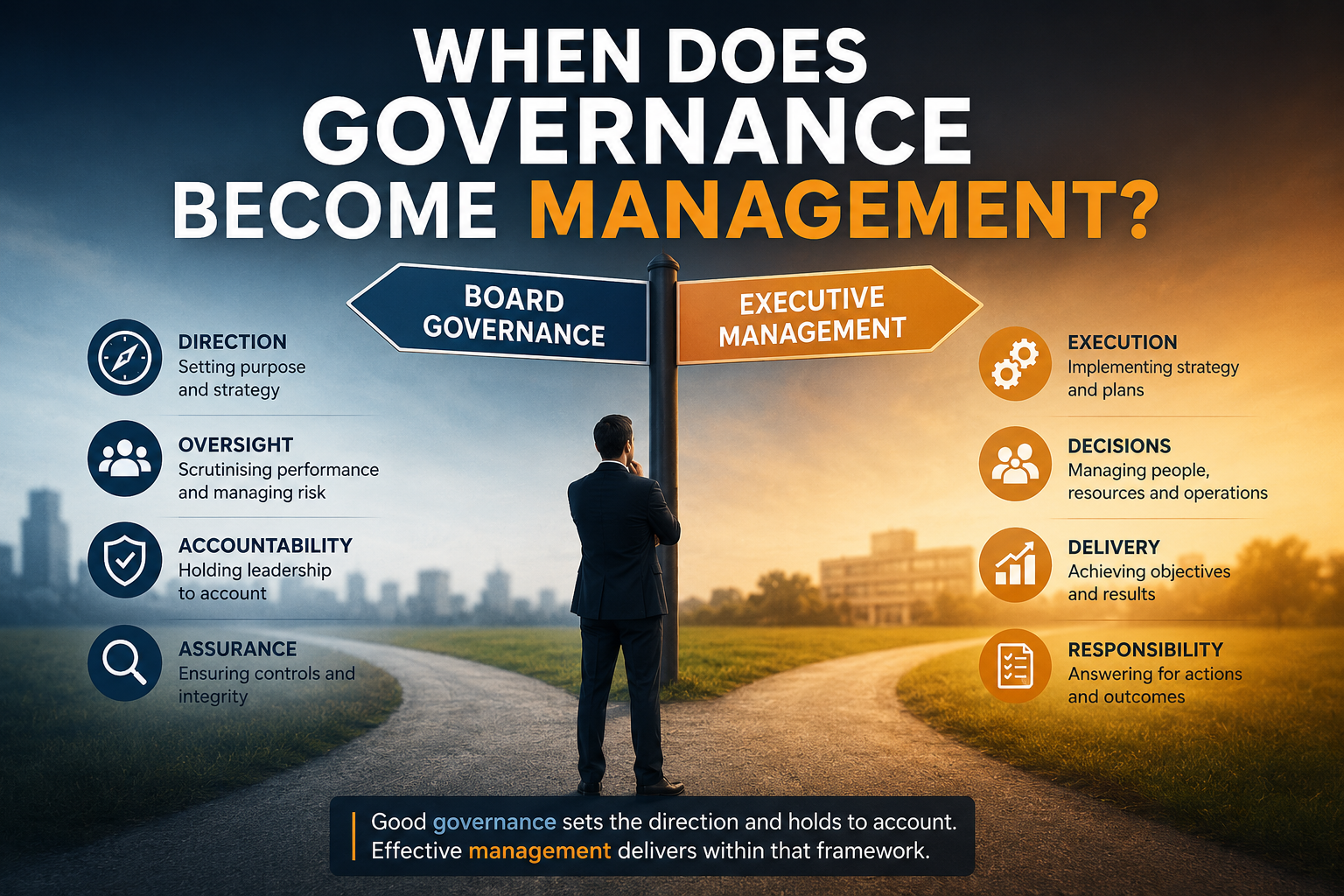
When Does a Board Cross the Line from Governance into Management?
The distinction between governance and management sounds straightforward. In practice, it is one of the most persistent sources of tension in boardrooms.
Boards are told to govern, not manage. Executives are told to manage, while remaining accountable to the board.
This division of responsibilities is attractive. It is also much less clear in practice than the maxim suggests.
A board cannot govern effectively without understanding what is happening inside the organisation. It cannot oversee risk without asking questions about operations. It cannot approve strategy without understanding whether that strategy can be delivered. And it cannot hold the executive to account without occasionally examining matters in considerable detail.
So when does legitimate oversight become interference? When does constructive challenge become micromanagement? And, perhaps more importantly, how can boards stay properly engaged without gradually taking over the executive's job?
The boundary is not between strategy and operations
One common explanation is that the board handles strategy while management handles operations.
That is useful shorthand, but it is not quite right.
Operational matters can have profound governance consequences. A safeguarding failure, major contractual dispute, regulatory breach, cyber incident or sudden deterioration in financial performance may begin as an operational matter but properly demand board attention.
Executives will also often play a substantial role in developing strategy. A board that attempted to devise strategy independently of the people responsible for delivering it would probably produce something rather detached from organisational reality. The conventional shortcut is:
strategy = board
operations = management.
A better distinction concerns authority, accountability and level of intervention.
The board determines purpose and direction, establishes the framework within which the organisation operates, decides matters reserved to it and holds the executive accountable for performance.
Management exercises delegated authority to run the organisation within that framework.
That means the board can - and sometimes must - examine operational matters. The important question is what it does once it has examined them.
Oversight is not the same as taking over
Consider a board concerned about falling staff retention.
It would be entirely legitimate for trustees or directors to ask: Why is turnover increasing? Which parts of the organisation are affected? Is this creating operational or financial risk? What does the employee data tell us? What is management doing about it? How will the board know whether the response is working?
Those are governance questions.
The position changes if individual board members begin deciding which managers should be moved, rewriting recruitment processes, instructing the HR team, or determining how particular employees should be managed.
The board has moved from seeking assurance about management's response to becoming part of that response.
The same distinction can be applied to almost any subject. A board can ask why a project is behind schedule without assuming responsibility for the project plan. It can challenge declining income without deciding which salesperson should pursue which customer. It can scrutinise complaints data without directing staff how to resolve individual complaints. It can require assurance about safeguarding without becoming the organisation's safeguarding team.
The dividing line is often not the subject being discussed, but the nature of the board's intervention.
Why boards drift into management
Few boards consciously decide to become operational. The drift is usually gradual.
Sometimes it begins with good intentions. A trustee has particular expertise and wants to help. A director sees a problem and knows how they would solve it. The chief executive is under pressure and welcomes additional support.
Sometimes the cause is lack of confidence. If information reaching the board is poor, directors compensate by asking for more and more detail. If commitments repeatedly fail to materialise, scrutiny becomes increasingly intrusive.
And sometimes the organisation itself creates the problem. Weak delegation, unclear committee responsibilities, and poorly defined executive authority leave a vacuum the board naturally fills.
There is also a behavioural dimension. For many board members, doing feels more tangible than governing. It can be more satisfying to solve a particular problem than to ask whether the organisation has the systems, leadership and capability to solve that category of problem consistently.
But a board's value rarely lies in being a parallel management team.
Expertise can make the problem worse.
Boards rightly seek trustees and directors with relevant skills. The difficulty arises when expertise becomes an alternative chain of command.
Imagine a trustee with substantial marketing experience. Their expertise should improve the board's ability to scrutinise the organisation's marketing strategy, understand performance and ask intelligent questions. It does not ordinarily mean that the trustee should start giving instructions to the marketing director.
The same applies to lawyers, accountants, HR professionals, technology specialists and former chief executives.
Board members should bring their expertise to the governance task, rather than converting their board position into an operational role.
This can require considerable discipline.
What would I do?
It is better replaced by:
What does the board need to know, decide or require assurance about?
Those are very different questions.
Delegation is central to the relationship.
The governance-management boundary becomes much easier to navigate when authority has been deliberately allocated.
A good scheme of delegation should identify which decisions are reserved to the board, which are delegated to committees, which belong to the chief executive and which may be exercised further down the organisation.
Current sector guidance reflects this approach: clear responsibilities across the board and executive team, explicit delegation and appropriate escalation arrangements are central to effective governance.
But delegation is more than a document. It represents an important governance bargain.
Within these parameters, you have authority to act.
In return, the executive exercises that authority responsibly, keeps the board appropriately informed and escalates matters when necessary.
Problems arise when either side breaks that bargain. A board that delegates and then routinely second-guesses decisions has not genuinely delegated. An executive that treats delegated authority as freedom from scrutiny misunderstands delegation just as seriously.
Delegation does not remove the board's ultimate responsibility; appropriate reporting and accountability arrangements should accompany delegated authority.
Accountability requires room to manage.
Another reason boards should be cautious about becoming operational is that it becomes difficult to hold someone accountable for decisions you have effectively made for them.
Suppose a board repeatedly intervenes in an executive project. It changes the implementation plan, determines priorities and directs particular actions. Six months later, the project fails. Who is accountable?
The chief executive may formally remain responsible, but the board has substantially constrained the executive's ability to exercise judgement.
Effective accountability requires both authority and responsibility.
If a chief executive is to be held accountable for delivering agreed objectives, they need sufficient delegated authority to decide how to achieve those objectives.
A board cannot sensibly demand accountability while simultaneously removing the discretion necessary to deliver.
But 'that's operational' is not a shield
The opposite problem also occurs.
Executives sometimes resist legitimate board scrutiny by describing uncomfortable questions as operational interference. That is equally unhealthy.
The board remains responsible for governance even where activities have been delegated. It needs sufficient information to understand performance, risk and organisational capability.
The board delegated this, so it is none of your concern.
That is not a sustainable position. Delegation changes who has authority to act. It does not extinguish oversight.
The executive should therefore be able to distinguish between a board asking for assurance and a board attempting to assume executive authority. Likewise, boards need to distinguish between an executive protecting legitimate delegated authority and one attempting to avoid accountability.
Healthy governance requires both sides to understand the difference.
When should a board go deeper?
Circumstances may justify considerably greater board involvement.
A serious regulatory issue, safeguarding concern, financial crisis, major litigation, leadership failure, or existential threat may require a board to examine matters in greater detail than would be appropriate in ordinary circumstances.
A board may also need to intervene where it has good reason to believe that management controls are failing or that information reaching it is unreliable.
Exceptional intervention should be recognised as exceptional.
The board should be clear about why it is intervening, what authority it is exercising, how long the intervention is expected to last and what needs to happen before normal delegation resumes.
Otherwise emergency governance has a habit of becoming ordinary governance.
Committees can blur the boundary
Committees deserve particular attention because they often sit directly on the fault line between governance and management.
A board committee may quite properly examine an issue in much greater depth than the full board. An audit and risk committee, for example, will naturally spend considerable time examining controls, assurance and risk.
But greater depth does not necessarily mean greater executive authority.
The committee's terms of reference should make clear whether it is there to decide, recommend, scrutinise or assure.
Those verbs matter.
A committee established to provide oversight can gradually become an operational decision-making body simply because its members know the subject well and meet management frequently.
Clear terms of reference and reporting arrangements help prevent that drift.
Five questions for a board that may be getting too operational
First: Who actually has authority to make this decision?
Look at the constitution, matters reserved to the board, scheme of delegation, committee terms of reference and relevant policies. Do not rely simply on custom.
Second: What does the board need from this discussion?
Is it being asked to decide something? To provide strategic direction? To scrutinise? To obtain assurance? Or merely to understand? If nobody can answer that question, the item may not be ready for the board.
Third: Are we asking management what it proposes to do, or telling management how to do it?
The former is often a legitimate challenge. The latter should prompt consideration of whether the board is assuming executive responsibility.
Fourth: Is the level of board involvement proportionate to the risk?
A routine operational matter and an existential regulatory crisis should not receive the same treatment.
Fifth: Who will be accountable for the outcome?
If the answer is the chief executive, the board should consider whether it is leaving the chief executive sufficient authority to deliver it.
These questions will not resolve every difficult case, but they usually reveal where the real governance problem lies.
The chair and chief executive relationship matters
No delegation scheme can fully compensate for a dysfunctional relationship between the chair and chief executive.
The chair needs to ensure that the board receives enough information to govern effectively without allowing individual board members to create informal reporting lines into the organisation.
The chief executive needs to respect the board's legitimate need for assurance without interpreting challenge as a lack of trust.
Both need to be able to say when the boundary is becoming blurred.
That requires trust, but not unquestioning trust.
The strongest chair-chief executive relationships combine clarity of authority with openness to challenge.
Good governance does not mean distance
The answer to micromanagement is not a remote board.
A board that knows little about the organisation, rarely challenges management and approves recommendations without meaningful scrutiny is not demonstrating good governance merely because it avoids operational detail.
The objective is appropriate engagement.
Boards should understand enough to make good decisions, recognise emerging risks, challenge assumptions and hold management accountable.
Executives should have enough authority to lead, manage and respond to changing circumstances without seeking board permission for every significant judgement.
The precise boundary will differ according to the organisation's size, complexity, maturity, circumstances and governing arrangements. In a small volunteer-led organisation, trustees may themselves perform operational roles; even there, good governance requires distinguishing when trustees are acting operationally from when they are acting as the governing board.
There is therefore no universal line on an organisational chart separating governance from management.
However, there is a useful test.
Is the board creating the framework, making the decisions that properly belong to it and holding others accountable for exercising delegated authority - or is it starting to exercise that delegated authority itself?
The first is governance.
The second is usually where governance begins to become management.